Choosing between Galala and Sinai Pearl limestone is one of the more common decisions builders, landscapers, and homeowners face when sourcing an Egyptian limestone for their Australian projects. Both stones come from the same country and share a similar sedimentary origin. They are also used across similar application areas such as pool surrounds, patios, alfresco, or indoor areas. However, they still behave quite differently once installed. If you are planning a driveway in Brisbane or a poolside installation in Sydney or a courtyard in Melbourne, knowing these differences can save a lot of guesswork later.
Let us compare these two limestones and what they offer. This will help you decide which one suits your project and which performs better.
Where These Stones Come From
Both Galala and Sinai Pearl limestone are quarried in Egypt. They are from different regions with distinct geological differences.
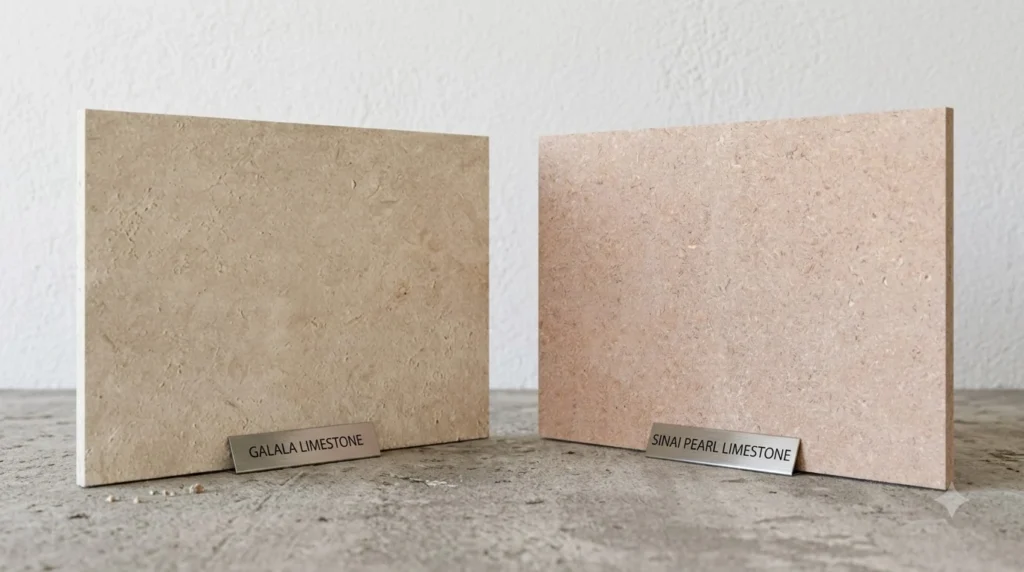
Galala limestone, also known as crema limestone, comes from quarries in the Galala mountain range. This area is known for producing fossil-rich limestone with warm beige & cream tones. This natural stone is formed over millions of years, which is why you will see fossil imprints and organic veining running through it.
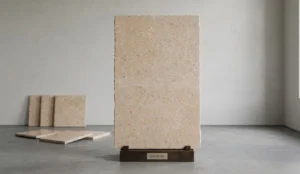
Sinai Pearl limestone is quarried in the Sinai Peninsula region. It carries a similar fossil-rich composition but tends to present a more consistent tan to beige tone. It has less dramatic veining compared to Galala. Some natural stone suppliers also market variations of this stone under names like Pearl Oyster, Dijon, Avani, or Perlato Royal, depending on the specific quarry batch.
Visual Differences That Should Matter
This is usually the first thing people notice, and it is considered a deciding factor for many construction projects.
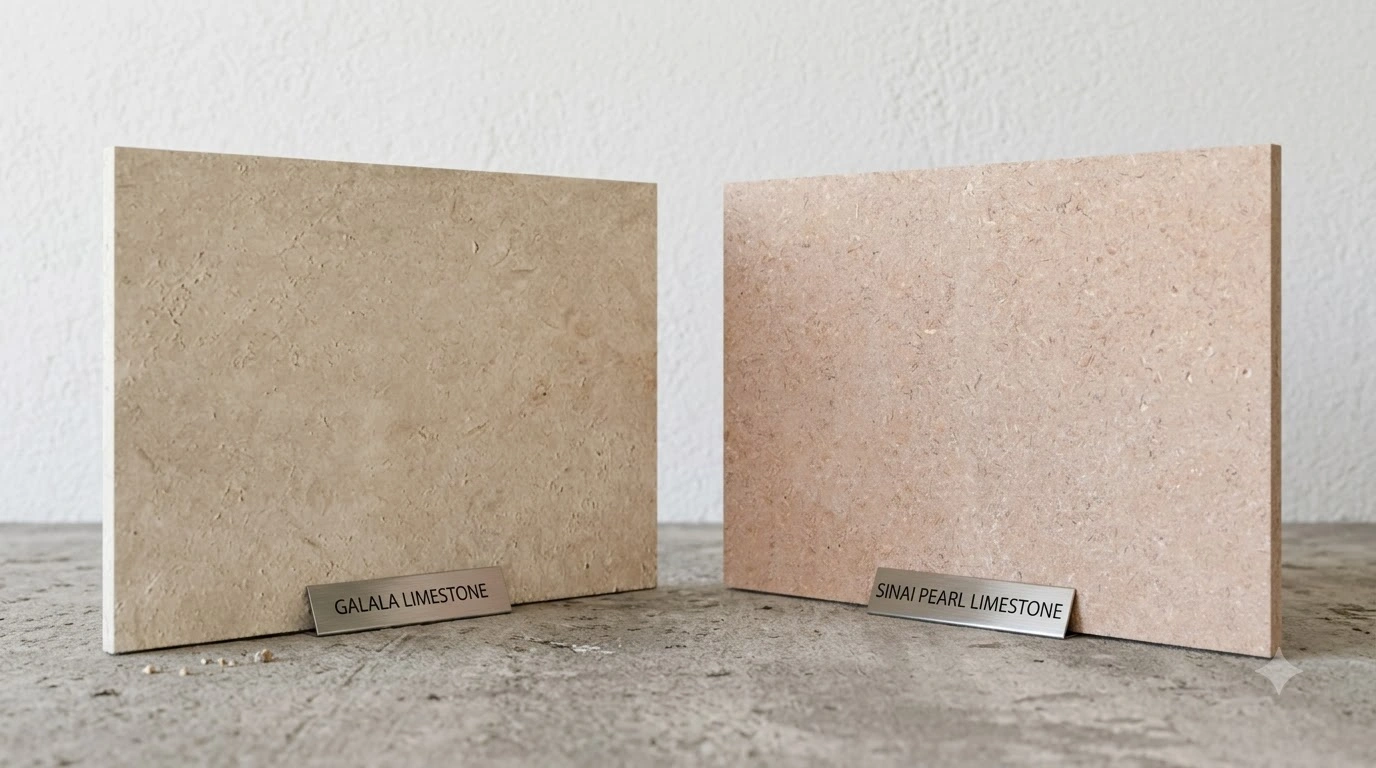
Galala limestone tends to show more visible fossils and shell imprints scattered across the surface. It has subtle colour variation from warm beige through to light cream. Each galala limestone tile has its own character. Architects or Builders use this product deliberately when a project calls for something that gives a unique texture with beautiful orange veining.
Sinai Pearl limestone presents a more uniform tan background with fine, consistent veining and occasional fossil markings. It is considered a calmer and even-toned stone. This makes it a strong choice for large-format areas like courtyards or commercial builds where visual consistency across a big surface matters more than individual tile character.
It genuinely comes down to whether your project wants a stone that feels naturally varied or one that feels calm and uniform across a large footprint.
Technical Performance Comparison
Numbers matter here, especially for driveways, pool surrounds, and high-traffic commercial areas across NSW, QLD, and VIC, where climate exposure varies.
| Property | Galala Limestone | Sinai Pearl Limestone |
| Density | Around 2,626 kg/m³ | Around 2,590-2,630 kg/m³ |
| Water absorption | Approximately 0.11-0.19% | Approximately 1-1.6% |
| Compressive strength | Around 821 kg/cm² | Around 93-99 MPa |
| Mohs hardness | Comparable to the standard limestone range | Around 3 on the Mohs scale |
| Frost resistance | Good for outdoor use | Confirmed frost-resistant as per European testing |
| Wear resistance | Strong & suited to heavy foot traffic | Rated at 22-25mm wear per Capon testing |
What this means practically is that Galala typically shows lower water absorption. It can be an advantage in wetter climates like coastal NSW or Queensland, where prolonged moisture exposure is more common. Sinai Pearl still performs well within accepted limestone standards and carries confirmed frost resistance. It matters less in most Australian regions, but it does speak to overall stability.
Both stones fall within a similar density range, so in terms of raw weight and structural handling during installation, there is not a significant practical difference.
Durability in Real Australian Conditions
Australia’s climate varies dramatically, and this affects which stone performs better in specific locations.
In Sydney and the coastal NSW regions, humidity and heavy rain are quite common. Galala’s lower water absorption gives it a slight edge here. It resists moisture penetration better over time, which can reduce staining risk during the rainfall periods.
In Brisbane and Queensland’s subtropical climate, both stones handle heat reasonably well. However, neither should be installed with a polished finish for outdoors. Polished limestone becomes genuinely hazardous when wet. Textured or honed finishes are the standard recommendation for outdoor use in this region. Now, Galala limestone is available at Stoneplanet in a sandblasted finish with tumbled edges, providing it with a high slip rating as per Australian standards.
In Melbourne and parts of Victoria, Sinai Pearl’s confirmed frost resistance rating offers a bit more peace of mind.
Neither stone is dramatically better across the board. The differences are real but modest, and both perform well within the general climate range that most Australian cities experience.
Product Formats: Tiles, Pavers, Cobblestones, Batons, and Crazy Paving
Both Galala and Sinai Pearl are available across a wide range of formats. This is why they are a popular choice for varied project types.
Natural stone Tiles are the standard format for interior flooring, wall cladding, and smaller courtyard areas. They can be utilized outdoors as well if the bedding beneath the tile is concrete. These come in consistent sizes and finishes. Usually, honed for outdoor use or sandblasted with tumbled edges are preferred for installation.
Outdoor Pavers are thicker cut pieces designed specifically for outdoor areas. Pavers in both stones are commonly finished with a sandblasted or acid-washed finish. This gives better slip resistance for exterior applications like patios, pool surrounds, and walkways.
Cobblestones are smaller and calibrated to thickness and dimension at Stone Planet. Available in mesh or loose pieces, galala limestone is one of the upcoming best sellers in this format. It is used for driveways, garden paths, and decorative borders. They create a more textured, old-world look and work particularly well in landscaping.
Batons refer to narrow, elongated stone pieces. They are used for step treads, edging, garden borders, or linear design features.
Crazy paving is the most demanded size across Sydney and Brisbane in natural stones. Galala limestone crazy paves are irregular, randomly shaped pieces. They are fitted together like a puzzle with visible grout lines between each piece. This format is popular for informal garden paths, courtyard flooring, and outdoor areas where a natural, organic layout is the goal rather than a precise grid pattern.
Both Galala and Sinai Pearl adapt well across all five formats, so the choice of format usually comes down to the specific area of the project rather than any limitation of the stone itself.
Cost Considerations for Australian Projects
Pricing between the two stones tends to be fairly comparable. This can shift depending on supplier sourcing, shipping volume, and current quarry output. At Stone Planet, these limestones are available at wholesale prices. Sinai Pearl is sometimes positioned as the more economical option. You must be thinking, why? It’s due to its more uniform veining which simplifies quarry processing and less wastage during cutting.
Galala has more varied fossil patterning, which can occasionally mean slightly more selective cutting to match tiles. This can add marginally to the cost of bigger projects. For smaller residential applications, this difference is usually negligible.
Freight from Egypt to Australian ports is a bigger cost factor than the raw material difference between the two stones. It is better to discuss shipping consolidation with your supplier if you are sourcing either stone for a project in Sydney, Brisbane, or Melbourne. It is preferred to purchase the standard sizes already in stock to get the best wholesale prices.
Which Stone Suits Which Project
Choose Galala limestone if:
- You want visible fossil character and warm, varied tones
- The project is in a higher-humidity coastal region
- You want a modern design
- Sandblasted Finish – You want a white color with light orange to yellow veining.
The area involves smaller sections where tile-to-tile variation adds visual interest rather than complicating the layout
Choose Sinai Pearl limestone if:
- You need a consistent, calm tone across a large surface area
- The project involves a big commercial forecourt or expansive courtyard
- You want a slightly more budget-friendly option for large-scale sourcing
- Frost resistance